PPC Pricing: How Much Does PPC Management Cost in 2024

Pay-per-click (PPC) advertising has quickly become one of the most popular forms of marketing. It’s not hard to see why; PPC can boost your visibility, and ultimately, deliver higher sales. If you’re considering this approach, you’ve probably got a clear question, ‘how much does PPC management cost?’. Well, we’ll explain that, and more, in this article.
What is PPC?
Under PPC advertising, you’ll pay a certain amount for advertising on Google (you can pay for ad space on other search engines, but let’s be honest, controlling 83% of search engine traffic, most people want their ads on Google).
Under PPC, advertisers bid for keywords. It should be noted that you aren’t actually paying for the ad space itself. Instead, you’re charged each time someone clicks on your ad.
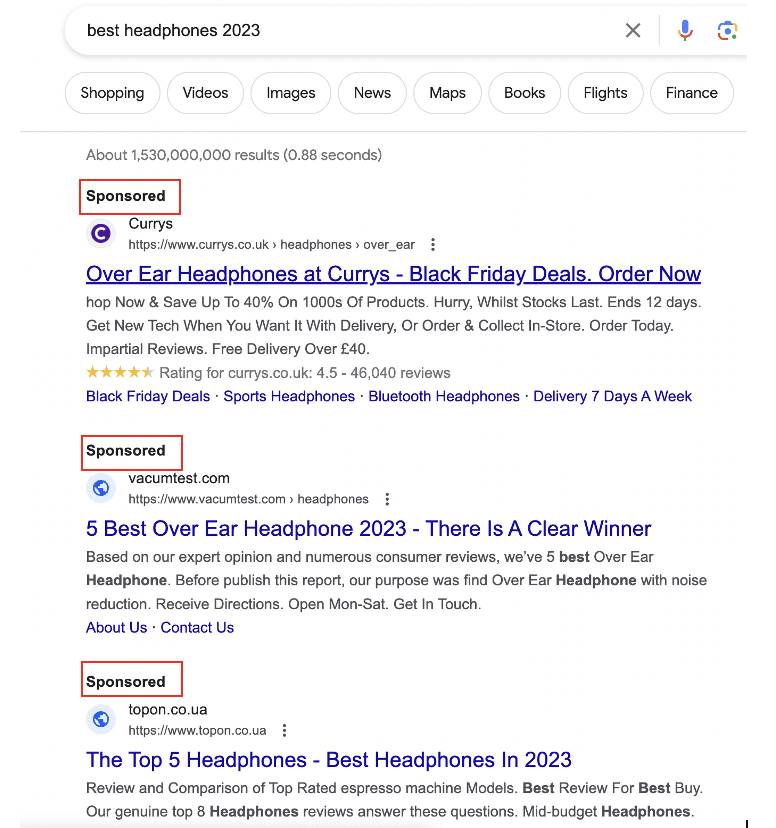
The image below shows one of the ways that PPC ads are displayed on Google. As you’ll notice, the ads appear before organic search results. They’re easy to spot due to the ‘Sponsored’ tag.
How much does PPC management cost?
Determining PPC cost is a little tricky; there is no set cost for advertising space. Your ad spend will depend on various factors, these include:
- Your chosen keyword.
- Your advertising budget.
- Your ads’ quality score.
- The ad networks that you target.
Whether you’re managing niche B2B PPC or a standard B2C campaign, understanding the costs is essential. Let’s look at these factors individually.
Your chosen keyword
Keywords are central to your ad strategy and are basically popular search terms. For example, ‘buy insurance package’ or ‘best headphones 2023’. Including keywords in ads makes them more likely to show up when a user searches for the corresponding search term.
And of course, the more popular the keyword, the more you’ll be paying. Keywords are categorized into different groups, each has an impact on the price. You should consider each group in your keyword research, this includes:
- Short-tail keywords: Generic search terms that don’t consist of more than one or two words. For example ‘car repairs’, ‘cycling’, or ‘shower gel’.
- Long-tail keywords: Longer keywords are usually made up of two or three search terms. They give you more of a clue about a user’s search intention, eg. ‘shower gel for sensitive skin’.
- Branded keywords: Contain the name of a brand such as ‘best Toshiba laptop’.
- Transactional keywords: Hint that a user is intending to buy a product. For instance ‘low cost car insurance’.
- Locational keywords: List a location, for example, ‘Blackpool best hotels’. These keywords are very useful to businesses that deal with localized marketing.
- Informational keywords: These are general user queries and are not usually connected directly with sales. A user might search for ‘directions to Ikea’ or ‘Marmite ingredients’.
Core keywords vs modifiers
When working with keywords, you’ll need to use both core keywords and modifiers. It might sound a little complicated, but in reality, the difference is pretty simple.
Core keywords are the main keywords in your advert. In other words, they’re the reason your ad exists. For example, ‘mechanic’. The modifier supports the keyword by providing additional context ‘best mechanic near me’, ‘cheap mechanic, etc.
Modifiers are essential, but alone won’t help you get maximum value from your PPC. Let’s think about it in the context of the example above ‘cheap mechanic near me’ and cheap mechanic’. In both cases, whilst you are using different modifiers, you are using the same core keyword.
Most advertisers select a variety of relevant keywords, though don’t go over the top with them! Try to mix up the core keywords that you use. Whilst mechanic might be one example of a core keyword, there are plenty of other relevant choices. For instance, ‘tire repair’, ‘oil change’, and ‘wheel alignment’ are all examples of related core keywords.
Not only can this give better value, it can deliver a much wider reach.
Short-tail vs long-tail keywords
Smaller businesses won’t have the mammoth budgets of some of their larger competitors. This makes keyword bid setting more difficult.
If you’re in this situation, don’t panic! One way of controlling the cost of your PPC ads is by using a mixture of short-tail and long-tail keywords. Short-tail keywords tend to be the most expensive; they’re the terms that most people search for.
Long-tail keywords on the other hand are often slightly cheaper. They target a smaller group of people but also have fewer bidders – all the big names are bidding on short-tail keywords. Less competition means your ads are more likely to place highly in search results.
So, whilst you might bid on the short-tail keyword ‘leather jacket’, try to think of small long-tail alternatives. For instance ‘designer vegan leather jacket’.
Advertising budget
It goes without saying that the biggest restriction on your PPC choices is your overall budget. If you allocate a smaller PPC budget, you’ll have to restrict your choices. Of course, there is a strong correlation between budgeting and success.
If you set a budget that is too small, you won’t get the results you need. In effect, you’ll be wasting money on ads that aren’t likely to reach many people. The trick is setting a PPC budget that both suits your wider goals and fits with your business’s finances.
With that in mind, let’s look at some of the factors that impact your ad budget.
Industry benchmarks
PPC pricing will vary greatly depending on your industry. The logic behind this is simple. Industries that tend to get the biggest payouts, such as insurance, are charged more per click.
In May 2023, Semrush conducted a study of selected industries advertising on Google Ads. They found that online education had the biggest CPC – with advertisers being charged a whopping $9.35 per click. The electronics industry had a very different experience, being charged only $0.68 per click.
So, when budgeting for your PPC advertising, bear in mind the cost of your industry’s CPC.
Your target audience
Your target audience will have big implications for your required budget. A broad target audience, for example, men in their fifties, will be more expensive. A narrower audience that targets a specific group of people, such as female cyclists based in France, will cost less.
That’s why it’s vital that you pinpoint your audience as accurately as possible before planning your PPC budget. When researching your target audience, try to include some of the following steps:
- Create buyer personas – This is a description of a fictional person that represents your target audience. This should include factors like their demographic, interests, and buying behaviors.
- Look at the data – When it comes to online advertising, data is always your friend. Why not leverage GA4 for PPC to dig deep into your data and get the best understanding of your user base? You can also look at data from previous campaigns to see which groups your ads resonated with.
- Outline who isn’t in your target audience – It’s just as important to know who you don’t want to target in your ads. A clear list of groups that should be avoided in your advertising will help prevent you from wasting money.
The competition
On advertising tools like Google Ads, you don’t need to outbid everybody, just the ad directly above you. Try to get a sense of competitors that are at a similar level to your business. How much are they allocating to their budgets?
To find this information, you’ll probably need to use a specialist tool. There are plenty of ad intelligence tools that can help you in this area. Google Ads itself can give you a lot of information. Just head to ‘Campaigns’ > ‘Impression Share’.
From here, you can see the number of impressions attributed to your ads in comparison to your competitors.
This screen doesn’t actually tell you how much competitors are spending on their ads.
But by keeping on competitor impressions, you can get an idea of when they are increasing their ad spending.
If competitor impressions increase, it’s a good indication that campaign spending is increasing. You can use these results as a guide to help inform your spending.
Campaign duration
How long should your campaign last? You could blow your budget on one short targeted campaign. Or, you spread your budget across a longer campaign. The longer your campaign, generally speaking, the more money you will need to allocate.
There is no right answer with regard to campaign duration. Try to bear the following points in mind.
- Is your product or service available only for a limited time or seasonally?
- What are the specific goals for your campaign?
- What platforms do you want to include in your campaign?
Your Ads’ quality score
We’re using the Google term ‘quality score’ here as an umbrella term. If you’re advertising on Facebook, you’ll instead be assigned a ‘relevance score’.
A quality score is an assessment of what value your ad brings to its intended audience. Quality score is graded from one to ten (with lower numbers being better). Quality score has a big impact on your PPC pricing. Ads with lower quality scores will be charged more for advertising space.
And just because you’re spending more money, it doesn’t mean you’re guaranteed prime ad space. Even though you spend more, you end up behind someone with a higher quality score.
With that in mind, let’s look at some of the factors that influence quality scores.
Quality of your copy
Try to put yourself in the shoes of your customer for a moment. If you see an ad that is filled with typos, grammar mistakes, and random formatting, it’s not likely to fill you with confidence. You’ll probably continue searching until you find an ad that is better written.
Ad platforms like Google feel the same way. Ads with poor-quality copy are automatically assigned lower quality scores.
There are a few steps you can take to make sure the quality of ads is up to scratch. The first step is to deploy the help of professional ad copywriting services.
Think about some of the following factors.
- Your headline – This is what potential leads will see first. Make it interesting. Before using any headline, do a quick search on Google using the same copy in your query. Are there a lot of similar headlines? If so, it’s probably best to go back to the drawing board.
- Backup your claims – If your ad reads ‘affordable laptops’ be sure to back up your claims. List your price ranges within the description to give searchers an incentive to click.
- Run your copy through a text editor – You won’t always spot errors in your copy. A text editor can work as an extra, more accurate pair of eyes.
Keyword relevance
The keywords included in your ad need to be relevant to the rest of the content. For example, if your keyword is ‘gardening’, and your copy is about hiking equipment, you’re not going to get a high-quality score. Always stay on topic and find keywords that align directly with your copy.
Standard of your landing page
Your ad itself isn’t the only factor to consider with regard to quality score. Ad platforms are also interested in the standard of your landing page.
Let’s imagine that a user clicks on your ad, arrives on your landing page, and then clicks off straight away. As far as platforms like Google are concerned, the user had a poor experience – they didn’t see what they wanted.
When ensuring a quality landing page, there are a few factors to consider.
- User experience (UX) – UX can be a big factor in sending users away from your landing page. Is your landing page easy to navigate? Does it accommodate mobile users? Finally, is it clear where users need to click to proceed? If the answer to any of these questions is ‘no’ you’ll need to consider a redesign. Again, GA4 for PPC will help here, helping you spot the pain points of your landing page.
- Relevent – Does the content on your landing page match the content on your ad? If not, users aren’t likely to stick around for long.
- Customized to the user: If a UK shopper comes to your page and sees the price in dollars, they might think that your product is not for them. Ensure that geographical elements like pricing adapt based on the visiting user.
The ad networks that you target
Once advertising online just meant access to a higher ranking on the search engine results page (SERP). But the times have moved on a little since then.
Whilst SERP advertising is one aspect of PPC, it’s only one element. Today, different ad platforms can provide huge outreach, ensuring that your ads can be seen across various places by larger groups of users.
The ad network that you choose will have big implications for your PPC pricing. All networks have different reach, functionality, and of course, pricing models.
With that in mind, let’s look at some of the different ad networks that are available to you.
Google Ads
Let’s start with the biggest example. As mentioned, Google is a mammoth of the advertising world. Today, it holds 76% of the market share, way ahead of any other ad networks. It’s not hard to see why Google Ads is so popular.
As well as providing access to Google’s search traffic, your ads can appear on websites signed up to Google AdSense (currently, nearly 59 million websites have signed up). Google Ads itself is great, filled with intuitive and easy-to-use dashboards, analytics, and more.
That said, the picture isn’t all rosy. As we’ve established, it’s no understatement to say that Google Ads is popular. That almost certainly means that your competitors are also using the platform. You’ll be entering a crowded market, and there’s no guarantee that your ads will be seen.
Secondly, if you’ve got customers in China, Google might not be the best option for you. The Chinese government has imposed severe restrictions on Google.
Facebook Ads
Facebook Ads is another popular advertising network. Facebook is the largest social media platform in the world, so you’ll instantly be getting access to a trove of users.
Not only that, but Meta (Facebook’s owner) also owns Instagram. This means it will be shown on both platforms, increasing your outreach.
Facebook takes a slightly different approach to Google, which focuses largely on search results. The platform uses demographic factors to find the users that are most likely to respond to an ad. This means that unlike on Google, a user doesn’t actually need to do anything to see your ad. If the algorithm detects that they are a good match, they’ll be shown your ad.
Ads pop up in a user’s feed alongside regular content. This means they feel more natural and users automatically feel less suspicious. You’ll be paying slightly less, too, as Facebook Ads are cheaper than Google.
Like Google, the Facebook Ads product isn’t perfect. Younger generations (Gen Z and onwards) use the platform less. Conversely, users that are aged 65 or over are also less common on Facebook. If your core audience falls into either of these groups, you might want to consider an alternative.
Bing Ads
Bing Ads (AKA Microsoft advertising) is the third major player in the online advertising space. Of course, we use the term ‘major’ loosely. The platform only has 9% of the desktop search engine (as of July 2023). Compared to Google, then, Bing is tiny. Why then should you use it?
Well, there are several advantages to using Bing compared to Google. Firstly, Bing is considerably cheaper, so it’s a strong option if you want to spend less. And, whilst Bing might reach a smaller group of users, there’s also less competition. You’ve got a stronger chance of your ads reaching an audience.
Bing offers similar services to Google. You pay for a spot on the SERP or on websites displaying Bing Ads. Alongside these benefits, you can also feature your ads on Yahoo!, MSN, and AOL.
Bing is generally associated with higher earners, so might be a better choice if you offer a high-end product.
When it comes to disadvantages, the most obvious downside is traffic. Bing won’t reach anywhere near as many users as Google. Don’t expect to be flooded with traffic using this platform.
FaQ
I need help with my PPC campaign
Managing an effective PPC campaign is difficult. Don’t worry, though, MeasureMinds is here to help! Maximize your advertising budget with our Google Ads service. Our expert team will handle everything from ad creation to optimization.
We’ll ensure you get the results for your business. Why not get a free quote today?
How much does PPC cost?
There is no easy answer to this question. Your approach to the campaign and the PPC pricing will be determined through many factors including:
- The keywords included in your advertising.
- The overall budget for your campaign.
- The quality of your advert and landing page, and the relevance of the keywords you include.
- The advertising networks that you target with your ads.
How can I find keywords?
Finding the right keywords for your campaign can be tricky. Luckily, there are plenty of PPC tools available to help you. Many of these tools can provide comprehensive keyword lists, including keywords by intent, helping you to boost audience targeting.
What is the difference between PPC and CPC?
Both Pay per click (PPC) and cost per click (CPC) describe the same process. PPC is the system that charges you each time someone clicks on your ad. CPC is the amount you’ll be charged each time someone clicks your ad.
How do I know if my PPC campaign was successful?
The easiest way to measure the success of your campaign is by keeping an eye on key performance indicators (KPIs). Of course, the right metrics will depend on the circumstances of your campaign. With that said, here are some KPIs utilized by most campaigns:
- Conversion rate – Tells you whether people are behaving the way you want when they reach your landing page. For example, clicking the CTA or signing to a mailing list. Conversion rate tracking is essential.
- Click-through-rate – The percentage of users that click the link on your ad.
- Cost-per-acquisition – The cost of acquiring each individual customer via your ad.
- Return-on-ad-spend – Whether you’re making more than you are spending on ad campaigns. This is a critical KPI for understanding the ROI (Return on Investment) of your campaign.
Wrapping up
If you came to this article expecting a definite answer, you might feel a little disappointed. We can’t give you the precise PPC pricing for your campaign. As we’ve explored, this is impacted by various factors, some more obvious than others.
Hopefully, though, we’ve helped you to better plan your PPC management. We’ve looked at some of the ways you can keep the costs of your campaign down, whilst boosting the quality of your ads. Why not put these tips into action, and build them into your strategy?