What are the Different Types of Consent?

Consent management may appear simple on the surface. A consent banner appears, a user clicks a button, and tracking either starts or does not.
In practice, consent comes in different forms, and each type answers a different question.
- Model: Do you start processing only after a clear “yes”, or do you start by default and offer a “stop”?
- Quality: Did the person understand what they agreed to? Did they actively and clearly agree? Could they choose intentionally?
- Control over time: Can they change their mind easily and manage preferences later?
We broke down the different types of consent to help you understand exactly what your business needs to stay compliant.
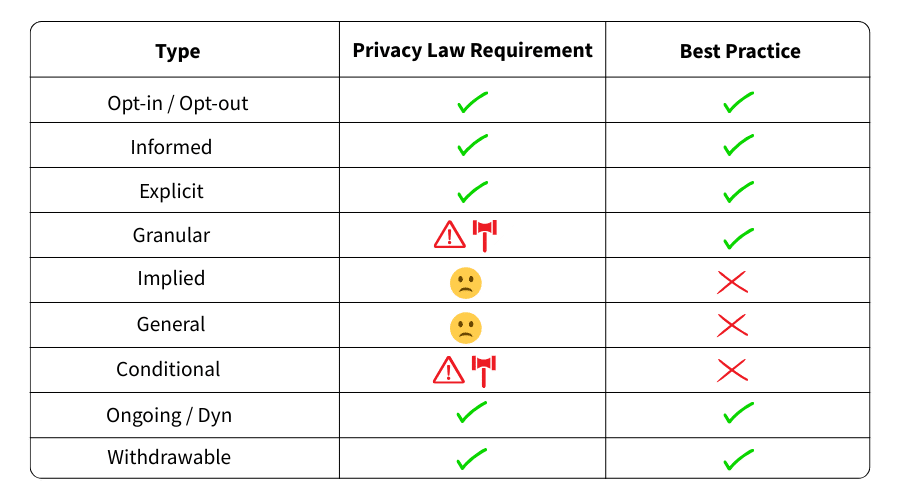
Two Main Models: Opt-in vs. Opt-out
Before looking at specific consent definitions, you must understand the two primary frameworks used in global privacy laws. They describe when you begin processing data and what you treat as the default.
Opt-in Consent
Opt-in consent means the answer is “no” until the user actively says “yes.” You cannot collect, process, or share any data until the user explicitly allows it.
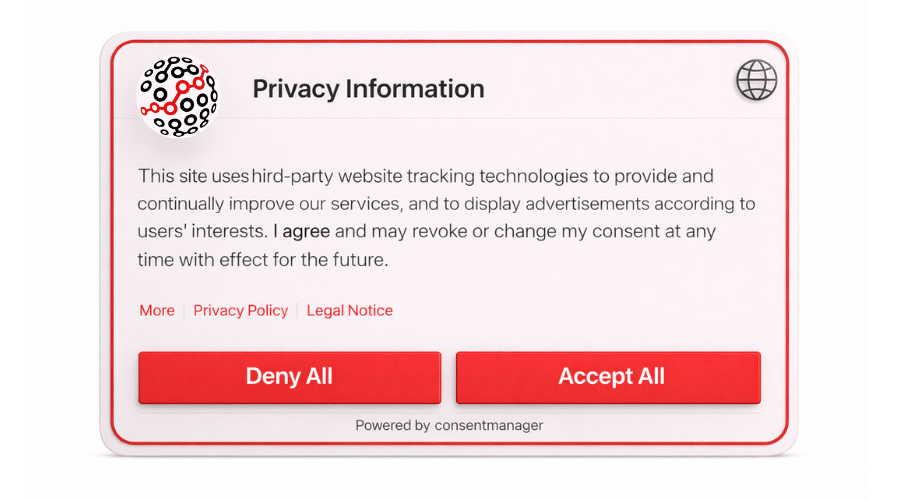
This is the standard for the GDPR in Europe. Under this model, you cannot drop non-essential cookies or add someone to a mailing list just because they visited your site. They must check a box or click a button confirming they want in.
Opt-out Consent
The opt-out model works in reverse compared to standard consent. Here, the answer is effectively “yes” until the user states “no.” You can generally collect and use data by default, provided you disclose this activity via a Notice of Collection, but you must give the user a clear way to withdraw that permission.
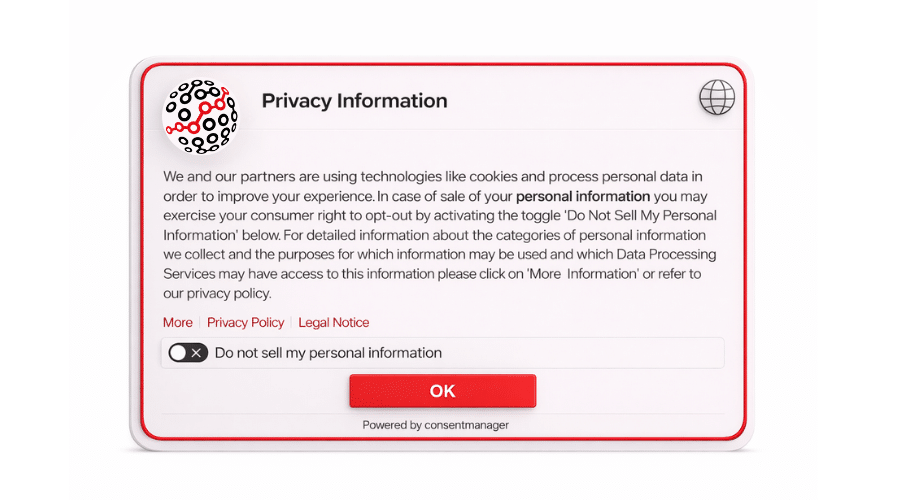
This framework applies to US laws like the CCPA and CPRA. For example, a website might track visitor behavior automatically upon entry, but it must provide a visible “Do Not Sell or Share My Personal Information” link (often in the footer).
If the user clicks that link, you must immediately stop selling or sharing their data for cross-context behavioral advertising.
Informed consent
Informed consent describes the standard of information you provide. Consent is invalid if the user does not know what they are agreeing to. It means you have told the user the full story before they say yes.
To achieve informed consent, you must explain:
- Identity: Who is collecting the data?
- Purpose: Why do you need it? (e.g., analytics, functional, marketing).
- Duration: How long will you keep it?
- Rights: How can they withdraw consent later?
If you hide this information in a long privacy policy link that nobody reads, you fail the requirement for informed consent. The explanation must be accessible and easy to understand.
Explicit consent
Explicit consent, also called express consent, leaves no room for doubt. The user takes a specific, positive action to agree. This is the gold standard for compliance.
This type of consent is not about what the user didn’t do. It is about what they did do.
Here are some examples of Explicit Consent:
- Typing an email address into a sign-up box and clicking “Subscribe.”
- Clicking “I Agree” on a cookie banner that blocks scripts until that click happens.
- Checking an unchecked box that says, “I consent to the processing of my health data.”
Under the GDPR, you almost always need explicit consent to process sensitive data such as health records, political opinions, or biometric data.
Granular consent
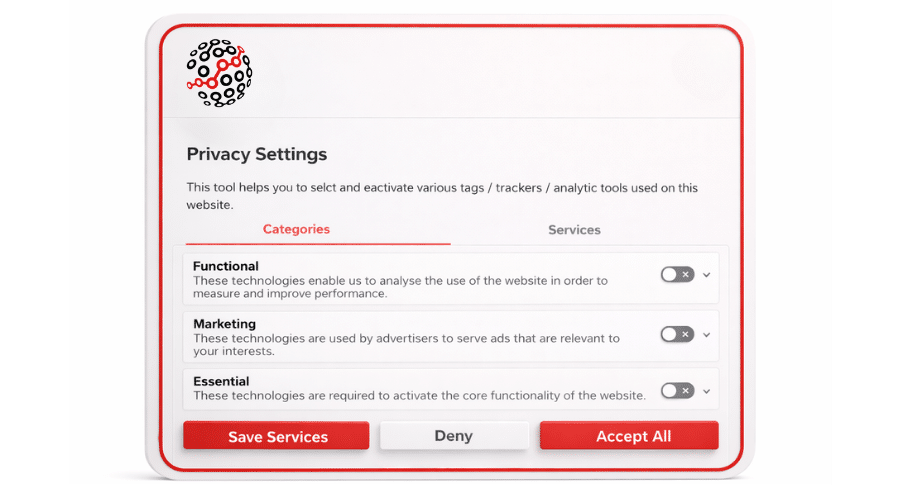
Granular consent prevents the “all or nothing” approach many businesses like to take. It gives users control over which data they want to share.
In practice, this means separating choices such as analytics, advertising, and personalisation, and letting users accept some while rejecting others.
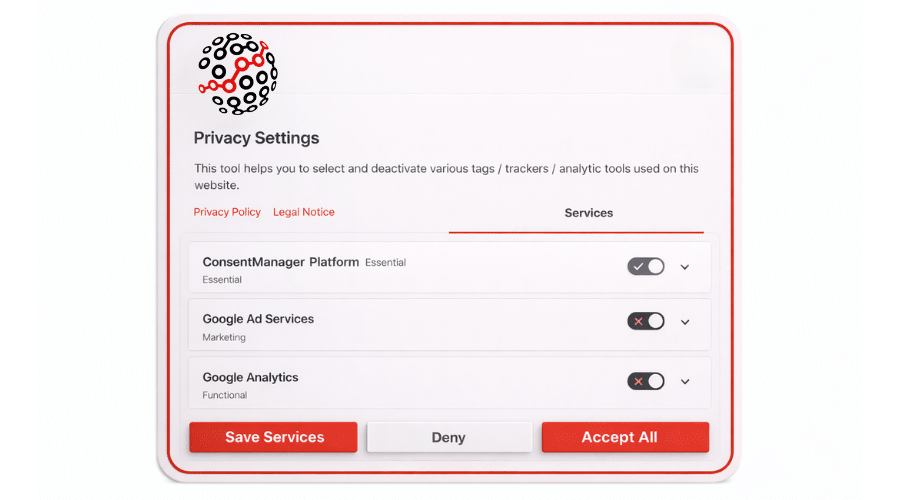
Imagine a user is comfortable with you analyzing site performance statistics, but does not want targeted ads following them. Granular consent allows them to say “yes” to analytics and “no” to advertising.
Regulators prefer granular consent because it respects user choice. Bundling everything together often violates GDPR standards.
Implied consent
Implied consent assumes agreement based on actions or inaction, such as scrolling, closing a banner, or continuing to browse.
It was once common to treat “continued use” as consent. Regulators and privacy teams increasingly view this as weak because it does not show a clear affirmative decision.
Implied consent makes it hard to prove the user chose anything. It also makes it easy for scripts to fire before the user has made a choice.
If your current setup relies on implied consent for non-essential cookies or advertising trackers, treat it as a risk area and plan a move towards explicit opt-in for those categories.
General consent
General consent is a broad “I agree” that covers multiple purposes at once.
You often see it in long terms of service pages that bundle service access, marketing permissions, analytics, and sharing with partners into one acceptance.
General consent causes compliance and trust issues because users cannot separate unrelated uses. Even if it feels convenient, it tends to fail the “clear choice” test in practice.
If you need agreement for essential service terms, keep that separate from optional marketing and tracking choices.
Conditional consent
Conditional consent happens when you gate content or services behind a data wall. You essentially tell the user, “You can only access this if you give us your data.”
This is a grey area. Under strict laws like the GDPR, consent must be “freely given.” If a user feels forced to consent just to use a basic service, that consent might be invalid.
Conditional consent can be lawful in some scenarios, but it becomes risky when the user has no real alternative. That is when consent starts to look pressured rather than freely given.
Acceptable use: A newspaper asking for a subscription (data + payment) to read articles.
Unacceptable use: A flashlight app refusing to turn on unless the user agrees to share their contact list.
Ongoing (dynamic) consent
Ongoing consent treats consent as something users can revisit, not a one-off click.
A good programme gives users a persistent way to manage their preferences, and it prompts them when you introduce new purposes or vendors. It also keeps consent information current, so the user sees the latest version of what you do.
This approach works well for subscription products, logged-in experiences, and any organisation that evolves its stack often.
Withdrawable consent
A central rule in data privacy is that consent is never permanent. Users have the right to change their minds. Withdrawable consent means a user can revoke permission just as easily as they gave it.
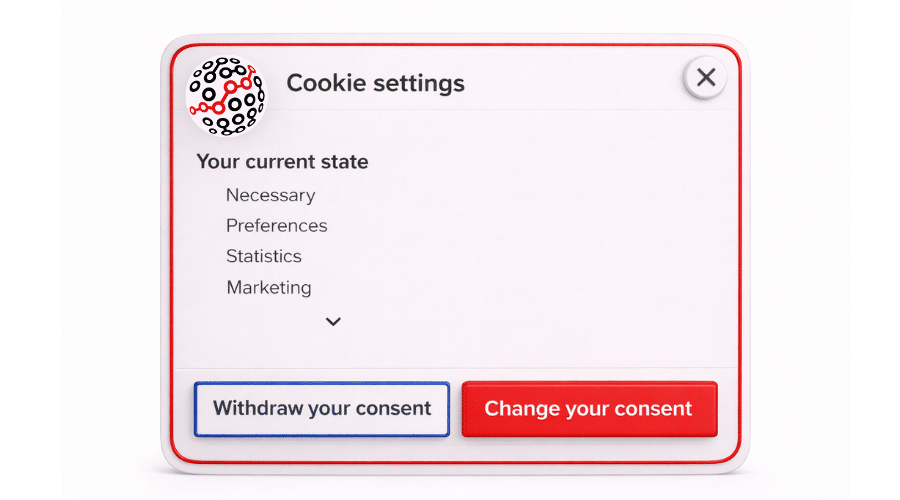
If a user subscribed with one click, they should be able to unsubscribe with one click. If they accepted cookies yesterday, they must be able to open a preference center today and reject them.
Once a user withdraws consent, you must stop processing their data for that specific purpose immediately. You cannot penalize them for leaving.
How these consent types affect GA4, GTM, and measurement
Consent choices do not only live in a banner. They need to flow into your tracking and vendor setup.
Teams often face problems such as:
- Tags firing before a consent state is set
- Tags are running under the wrong default state
- Mismatch between what the banner claims and what the site actually does
- Third-party scripts are loading outside your consent controls
These issues create two risks at once. They increase compliance risk and distort reporting, attribution, and conversion measurement.
What makes consent valid?
Most privacy laws share common requirements, even though the strictness varies by region and context.
Valid consent usually needs all of the following:
- Freely given: People need a real choice. You should not punish users for declining. For example, you should not block access to your entire site just because someone rejects marketing cookies.
- Clear and transparent: Users deserve to know what they agree to. Explain what data you collect, why you collect it, and who can access it.
- Specific and informed: Avoid broad statements such as “we may use your data for business purposes”. Spell out each purpose and let users choose which ones they accept.
- Easy to withdraw: Users must be able to change their mind as easily as they gave consent. This expectation appears in almost all modern privacy regulations.
Verify Your Consent Setup Actually Works
You need to verify that your site is doing what you expect it to do. Trusting the default settings on a plugin is rarely enough.
Manual testing of any consent setup is a slow & tedious process, which is also prone to error. Tools like Consent Mode Monitor exist to solve this specific headache.
It audits the gap between user choice and tag behavior, showing you exactly which tags fired without permission. This allows you to catch implementation errors before a regulator does.
Final takeaway
Consent isn’t a “set once and forget” type of task. It’s a living part of your marketing operations. Every time you add a new tracking pixel or publish a new version of your GTM container, you risk breaking your compliance setup.
The companies that stay out of trouble are the ones that treat consent as a core part of their user experience, rather than just a legal hurdle to jump over.
- Autoblock vs Google Consent Mode Categories: Pros & Cons - 22/04/2026
- Privacy Attack Vectors: What are They & How to Defend Against Them - 10/04/2026
- What are the Different Types of Consent? - 11/02/2026