Optimising Your Customer Journey For Growth

Activating personalised customer journeys is essential for growth. But how can you provide more tailored experiences? More importantly, how does zero-party data play a part? Let’s find out!
This is a webinar write-up of Phill Manson’s talk at GTM4ward V2. Find his slides here and a YouTube recording of his session below:
Why is the customer journey key?
There are likely to be three key pillars of the business scene in the next twelve months. These are:
Businesses driving profit not revenue
Paase has witnessed a change in the approach of its clients. Instead of marketing managers looking only at revenue growth, there is a focus on creating profitable actions. To do this, marketers must transition and train teams to move from discussions about last-click revenue. Instead, they should focus on the impact of marketing activity on lifetime value.
Boosted efficiency of email and day-to-day marketing
During the Covid pandemic, brands saw huge revenue growth and low acquisition costs. Unfortunately, some brands are still chasing this high. By focusing on volume more brands are often being marked as spam.
Brands want to send more and more emails but customers want to receive fewer, so the cost of acquisition is high. The only way to overcome this problem is to focus on process mining the customer journey.
Bringing personalisation to life using zero-party data
Customers’ expectations are changing. Modern consumers expect businesses to send automated communications relating to their unique journeys. Brands must work harder to bring more personalised content to consumers.
To do so, organisations must think about the customer first. This means a transition and process change to put the consumer at the heart of the journey. This is as opposed to sending generic brand messages to all customers. This means prioritising zero-party data capture points within your enterprise analytics to identify the propensity to purchase.
Messaging must be tweaked and improved at a one-to-one level. Key communications should be augmented with personalised content driven by zero-party data.
Customer journey mapping
When mapping customer journeys, it’s always useful to look at the past. When doing so, it’s helpful to ask some questions, including:
- What worked well that you’ve since stopped doing?
- Where are the drop-off points?
- What can you do to persuade customers to stick around?
- How can you retarget customers post activity?
- What programs have been successful (or unsuccessful in the past)?
By taking and evaluating previous learnings we can begin to map out and optimise user journeys. Generally, the best way to do this is to gather teams together and begin prioritising key work streams.
Every brand will have a unique customer journey. Consider the product you’re selling, the expected frequency, and the overall customer journey. How do consumers interact with your brand (e.g. via email, SMS)? These data points must be considered. If a customer has had a bad experience, you shouldn’t be messaging them with the latest offer.
It’s also useful to reflect on all the data capture points on your website. You might have a footer sign-up, a Klaviyo popup, and other data capture processes. All these processes capture zero-party data either at an email address level or preference level data. This information can deliver a highly personalised experience at scale.
To achieve this, it’s useful to create an urgency/impact matrix. You can gather lots of useful information during a customer journey workshop, but prioritising this data can be a challenge. You’ll need to balance customer service expectations vs the commercial benefits of sending more activity.
The below image shows an example of how this might look. By prioritising areas of high impact and high urgency, you can deliver a better, more personalised experience for consumers.
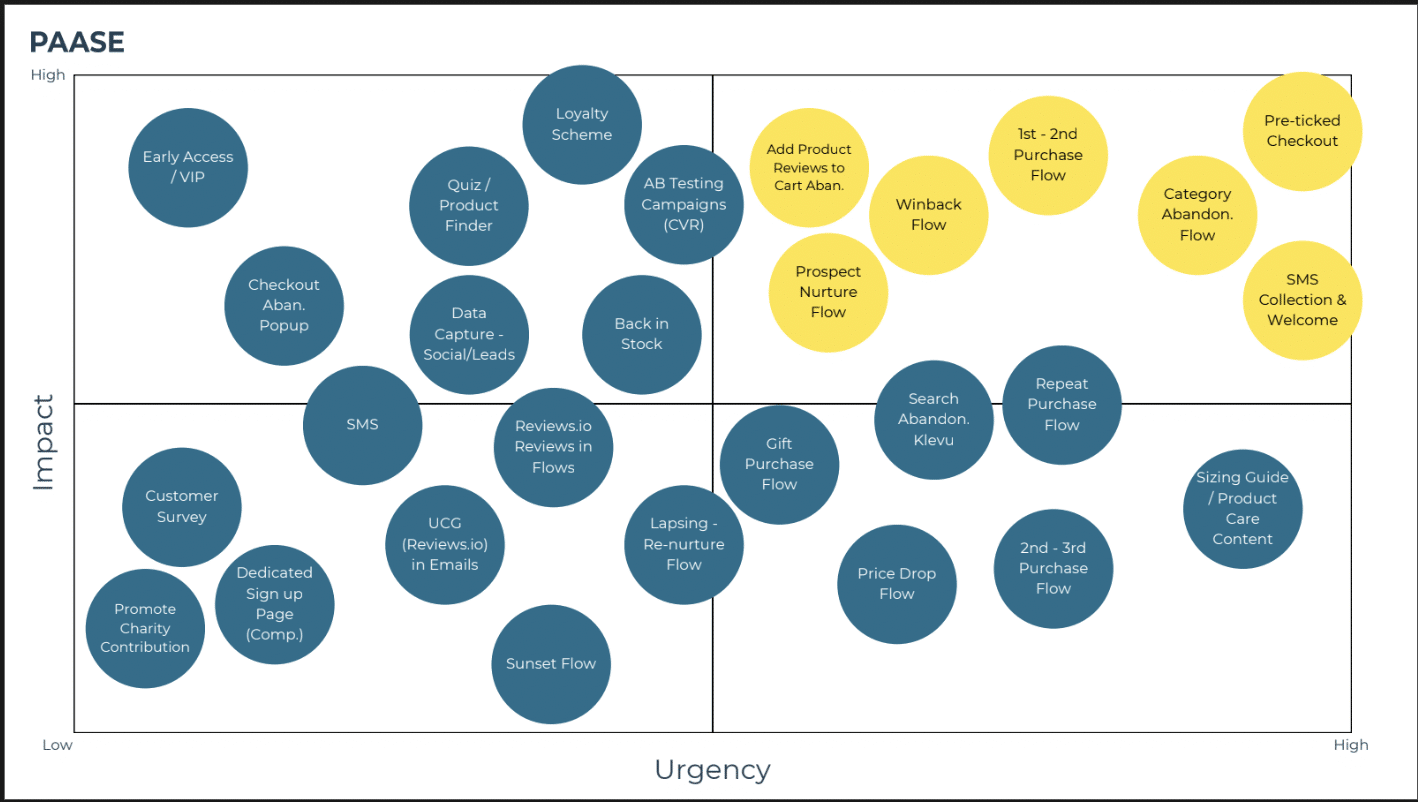
Urgency might represent a commercial risk or an issue with customer experiences. It’s worth keeping an eye on the most common call centre queries. By doing so, you can create an automated journey and resolve issues before customers reach the call centre. This way, email and SMS drive incremental revenue and reduce customer queries.
Email contribution baseline
Typically, we’d expect email to account for 15-20% of a brand’s total online revenue. This will fluctuate throughout the year and may increase or decrease in peak and out-of-peak seasons. In terms of volume, around 1-5% of all emails should be automated. These emails will be much more efficient and drive 25-30% of total email revenue.
By keeping a close eye on email performance, you can quickly gain a steer within customer journeys. If, for instance, automated emails account for 1% of your send volume, but produce 50% of email revenue, this suggests inefficiency within your campaign emails. In this scenario, you might consider the impact of sending fewer campaign emails on the customer journey.
How to use zero-party data
Realistically, there are only so many journeys you can create within a tool. You can think about the sales funnel (browser abandonment, add to cart, etc), and your welcome journeys (nurturing the process of taking a prospect or customer into a brand).
In both areas, you can be extremely broad, thanking consumers at each point in the journey. But to deliver a truly personalised experience, you should focus on zero-party data. Mixed with AI, this can deliver truly unique content for the customer.
Let’s explore an example of the power of first-party data. The image below shows a very generic system-generated message.

The image shows how the message can be repurposed using first-party data. You’ll notice that both the content and tone of the email have changed significantly.

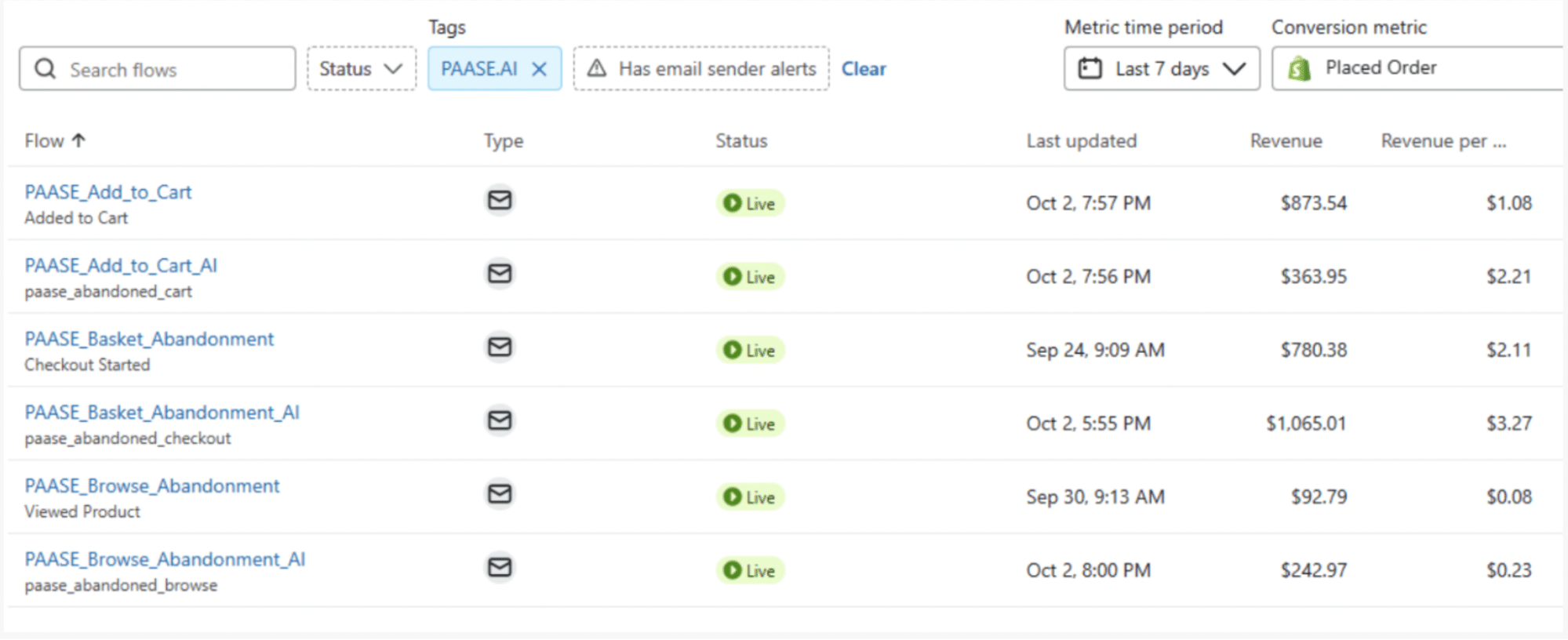
If you look at the image below, you can see the clear benefits of this approach. A 50/50 A/B test has been carried out, with half the traffic receiving personalised email content. Looking at the ‘add_to_cart’ metric, we can see that revenue per email has moved from $1.08 to $2.21. So, consider making your existing approach work more efficiently instead of focusing on volume.
What if I don’t have access to AI?
Not everyone will have access to AI-powered technology. Try to think from a Klaviyo perspective. If you’re using product merges and fixing products into templates, consider synching the product catalogues using dynamic content.
Klaviyo’s AI functionality allows you to select relevant products based on customer interactions. For instance, whether a shopper has purchased, viewed, or added an item to their wishlist. This way, you can determine the best products to recommend to first-time customers. These can then be pushed into welcome journeys in any series that goes out to a prospect.
Start thinking about how you can use the event data and user attributes to drive variation within templates. One caveat, however, is to watch the file size of templates. Files over 150kbs run the risk of clipping in Gmail.
Klaviyo – key takeaways for peak
To wrap up, let’s reflect on some Klaviyo best practices to take into peak season.
Ensure that UTM tracking is enabled and configured correctly
By default, Klaviyo puts UTM medium = Klavio. In reality, no one cares what ESP you’re using, instead it’s better to know the channel. So, you would change the UTM medium to ‘email’ and the UTM source to ‘email_campaign’ or ‘email_automation’. Additionally, make sure campaign tracking is activated, as this is switched off by default.
Ensure that customers receive flows as a priority over campaigns
Currently, there is no way of gaining a centralised view of SMS for UTM tracking with Klaviyo. Instead, you can override the UTM tracking in each SMS. For UTM medium you input ‘SMS’ and for UTM source choose ’SMS_campaign’.
Use email engagement segmentation to manage frequency to allow for better inbox placement
For better deliverability going into peak times, it’s important to monitor email engagement. For this, you might use email engagement segments (containing users who opened an email). This way, you can understand which groups of users need a break from activity. You can then reengage these users during peak times.
Ensure that you have ‘add to cart’ tracking enabled
Klaviyo has made this much easier recently thanks to an update to its configuration. Generally, if you see lots of revenue coming from basket abandonment, you’ll see the same from adding to cart. So, there can be a sizable uplift from enabling this feature.
Ensure that customers receive flows as a priority over campaigns
Flows and automations are based on a user’s last interaction with your business. It’s important to prioritise these over a mass broadcast, as these prospects are much more likely to convert. Remember, to measure user interactions accurately it’s better to use Klaviyo server-side.
Remember that a ‘blacklisting’ will take 6-8 weeks to recover from
If your deliverability is so poor that you’re hitting multiple spam traps, recovery can take time. It’s wise to be mindful of this as you go into peak. A ‘less is more’ approach can help you to avoid the blacklisting problem.
If your policies allow, activate anonymous visitor tracking for greater visibility and future identification
Klaviyo can start gathering information about anonymous visitors. When an email address is associated with the cookie, it can tile historical browsing data together. This provides a much stronger view of the customer experience.
About Phill Manson
With over 15 years of experience in email marketing working for enterprise brands such as Travelodge, Avis car rental and Interflora, Phill Manson has built and grown PAASE from a freelance consultancy to a full-scale agency. With a strong commercial focus, Phill and the PAASE team work with brands from various industries to help them profitably increase ecommerce revenue from email and SMS marketing through zero-party data-driven strategies.